The launch comes as India’s startup ecosystem enters a more disciplined phase. Investors are increasingly examining governance, financial controls, execution capability, and sustainable growth before committing capital. While ambitious ideas and large market opportunities remain important, venture firms are placing greater weight on businesses that demonstrate operational maturity and long-term viability.
The Framework Was Inspired by Real Investment Conversations
According to Dr. Ghosh, the idea behind Elevent Index was shaped over several years rather than developed overnight. During investment reviews, he found himself consistently assessing companies through multiple criteria that existed only as an internal thought process.
The turning point came when another investor questioned why this evaluation method had never been documented.
“That question stayed with me,” Dr. Ghosh said. “I realised the process I trusted most had never been written down. If it could improve investment decisions, it needed to become a framework others could understand and use.”
That reflection eventually led him to begin formalising the methodology into what later became Elevent Index.
Founder Feedback Changed the Direction
While refining the framework, Dr. Ghosh expanded his research beyond investors and began speaking with startup founders about their fundraising experiences.
A common theme quickly emerged. Many founders said they could accept a funding rejection if they understood the reasons behind it. What they found difficult was receiving broad responses that offered little guidance on improving their businesses.
“Several founders told me they wanted honest feedback, not comforting language. That made me realise a structured assessment could help both sides of the investment table,” he said.
Those conversations influenced the framework’s design by placing equal importance on transparency and measurable evaluation.
Looking Beyond Traditional Investment Signals
Startup investment decisions often combine financial analysis with qualitative judgment. Investors typically evaluate founders, market size, product differentiation, competitive positioning, customer growth, and business models before deciding whether to proceed.
However, these factors are not always assessed through a common structure, making comparisons between startups more difficult.
Elevent Index attempts to address that challenge by bringing multiple evaluation criteria into one integrated framework.
Rather than relying heavily on founder charisma, valuation expectations, or presentation quality, the framework examines business fundamentals alongside fundraising preparedness.
The objective is not to replace investor judgment but to support it with a consistent analytical process.
Three Independent Scores Form the Core of the Model
The framework is built around three primary assessment metrics.
The Investment Quality Score (IQS) evaluates the strength of the business itself. It measures eleven dimensions that include leadership capability, market opportunity, product innovation, financial discipline, governance standards, operational readiness, competitive positioning, customer traction, investment potential, and long-term sustainability.
The Funding Readiness Score (FRS) examines how prepared a startup is to raise external capital. Areas assessed include financial reporting, legal documentation, governance, fundraising strategy, due diligence preparation, and transaction readiness.
These two assessments are then combined to generate the Capital Readiness Score (CRS), which provides an overall view of a company’s preparedness to attract and manage investment capital.
According to Dr. Ghosh, separating these areas creates a more realistic understanding of a startup’s position than using a single investment score.
Why Readiness Matters as Much as Quality
One of the central principles behind Elevent Index is that a strong business does not automatically become an investment-ready business.
Companies may possess innovative products, experienced leadership, and growing customer demand while still lacking investor-ready financial systems, governance practices, legal compliance, or fundraising documentation.
Likewise, a startup may appear highly polished during investor presentations but still face deeper weaknesses in execution, operational processes, or commercial viability.
By assessing business quality separately from fundraising readiness, the framework attempts to identify where improvements are actually needed before investment discussions move forward.
This distinction reflects a growing trend within venture capital, where investors increasingly expect operational preparedness alongside innovation.
A Response to India’s Evolving Startup Market
India remains one of the world’s largest startup ecosystems, producing companies across sectors including financial technology, software, healthcare, artificial intelligence, manufacturing, logistics, and clean energy.
Yet the investment environment has changed significantly over recent years.
Rather than pursuing rapid expansion at any cost, many investors now emphasise sustainable growth, governance standards, capital efficiency, and responsible financial management.
Market observers believe structured evaluation tools can improve consistency across investment committees by allowing startups to be compared through defined business parameters instead of subjective impressions.
Elevent Index has been introduced within this changing environment, where analytical decision-making is becoming increasingly important.
Built From Engineering, Finance and Business Strategy
Dr. Bitan Ghosh’s professional background combines engineering, finance, infrastructure consulting, business strategy, and research.
He completed his Bachelor of Technology in Civil Engineering before earning an MBA specialising in International Business and Finance. He later received a Doctor of Business Administration with research focused on corporate finance.
His career includes engineering assignments in Kuwait, leadership positions in technology and consulting organisations, infrastructure advisory work, and enterprise management. He currently serves as Managing Director of Ghosh Group, overseeing business strategy, consulting, and organisational development.
This multidisciplinary experience influenced the design of Elevent Index by combining analytical thinking with practical investment evaluation.
Recognition Across Business Publications
Over the past few years, Dr. Ghosh has received recognition through national and international publications covering entrepreneurship, leadership, and business strategy.
His work has appeared in Mint, Dainik Jagran, ABP News, Mid-Day, Nationwide Awards, The Telegraph, and NY Weekly, documenting different stages of his professional journey and the development of Elevent Index.
The framework also reflects growing research activity emerging from Kolkata, a city with a longstanding commercial history that is increasingly contributing to discussions around entrepreneurship, innovation, and startup investment.
A Framework Focused on Better Investment Decisions
Startup investing will always involve uncertainty, and no analytical framework can remove every risk associated with backing young companies. Markets evolve, customer behaviour changes, competition increases, and execution challenges remain part of entrepreneurship.
Even so, structured evaluation methods can help investors make more informed decisions by reducing reliance on subjective impressions alone.
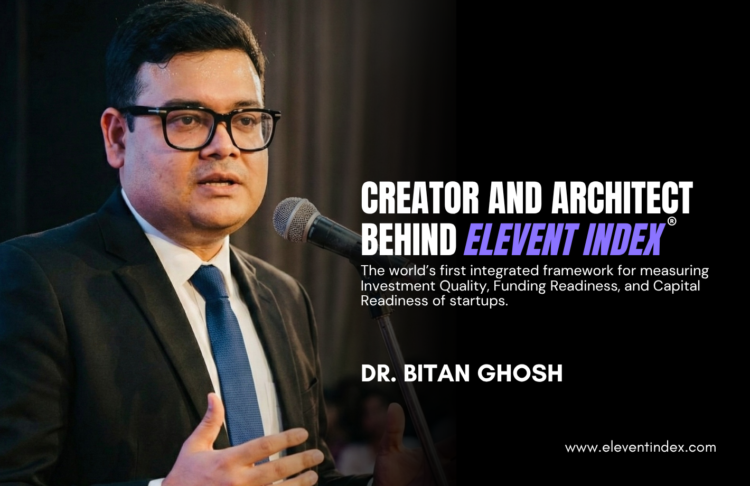
Elevent Index represents one attempt to introduce greater consistency into startup assessment by examining business quality, fundraising readiness, and capital preparedness through separate but connected measures.
As investors continue seeking stronger governance, financial clarity, and operational maturity, frameworks that encourage disciplined evaluation may become an increasingly common part of investment discussions. For Dr. Bitan Ghosh, Elevent Index is intended to support that shift by providing a structured way to understand not only whether a startup has potential, but whether it is genuinely prepared to receive and deploy investment capital.
Disclaimer: This report has been prepared using information shared by the subject along with publicly available material. Readers are encouraged to conduct independent verification where necessary.